Daily drawdown is one of the most important prop firm rules because it controls how much you can lose in a single trading day. This guide explains how it works, why different firms calculate it differently, and what traders should check before buying a challenge.

What Is Daily Drawdown in Prop Firm Rules?

Most traders do not lose prop firm accounts because of one bad trade. They lose them because they do not realise how fast daily losses can stack.
Challenge fees, account sizes, profit targets, and payout splits are easy to compare. They are visible on the pricing page, and they make one firm look more attractive than another. But those are not always the rules that decide whether an account survives.
Daily drawdown often does.
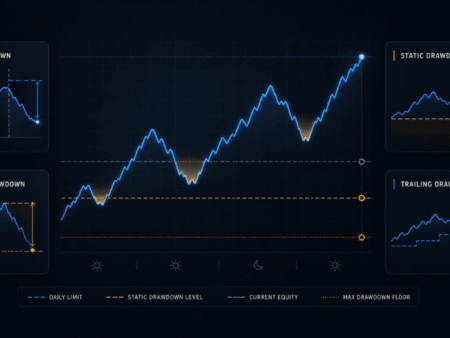
Daily drawdown defines how much a trader can lose in one trading day before the account is paused, restricted, or breached. It affects position sizing, open trade management, overnight risk, and how much room a trader really has after an early loss.
The complication is that CFD prop firms do not all calculate this rule the same way. A 5 percent daily drawdown limit at one firm can behave differently from 5 percent at another. It may be based on the initial balance, the previous day’s closed balance, or the higher of balance and equity.
Some firms count floating losses. Some reset at midnight server time. Some pause the account when the limit is reached, while others treat it as a full breach.
This is why daily drawdown should not be read as just a percentage. The structure behind the rule matters more than the number itself.
Key Takeaways
- Daily drawdown is the maximum amount a trader can lose in one trading day.
- The rule may also be called daily loss limit, maximum daily loss, daily pause, or daily simulated loss.
- The same percentage can behave differently depending on how the prop firm calculates it.
- Floating losses may count, not just closed trades.
- Reset time matters because open losses can carry into the next trading day.
- Some firms pause the account when the limit is hit. Others treat it as a breach.
- Daily drawdown is different from maximum drawdown. One limits daily loss. The other limits total account loss.
- A low challenge fee means very little if the daily drawdown rule does not fit your trading style.
What Daily Drawdown Means in Prop Firms
Daily drawdown is the daily loss limit of a prop firm account. It defines the maximum amount the account can lose within one trading day before the firm takes action.
That action depends on the firm. Some firms may pause trading for the rest of the day, close open trades, restrict the account, or treat the limit as a hard breach. In stricter models, hitting the daily drawdown limit can terminate the challenge or funded account.
The rule is simple at the surface. The difficulty is in the calculation.
A trader should not only ask:
| What is the daily drawdown percentage?
The better question is:
| How does this firm calculate daily drawdown?
That is where the real risk sits.
How Different Prop Firms Apply Daily Drawdown
Different CFD prop firms use different daily drawdown mechanics.
| Prop Firm | Daily Drawdown Model | Practical Meaning |
| The5ers | Daily Pause can use the higher of balance or equity | Open trades can affect the calculation |
| FundedNext | Daily loss limit can be based on initial balance | Easier to track because the base is fixed |
| Funded Trading Plus | Instant Program uses prior day closed balance | Daily room can change after each trading day |
| Alpha Capital Group | Product-specific daily risk models | Rules may differ between account types |
This is where many comparisons go wrong. Two firms can show the same daily drawdown percentage, but the trading experience may not be the same.
One account may give a fixed daily room. Another may adjust based on the previous day. Another may include floating loss more aggressively because the rule is tied to equity.
The trader is not only choosing a number. The trader is choosing a risk model.
The Five Things That Actually Matter
Daily drawdown has several moving parts. These five factors determine how much room you actually have during the trading day.
| Factor | Why It Matters |
| Reference point | Defines what the daily limit is calculated from |
| Floating loss | Open trades may reduce remaining room |
| Fees and commissions | Trading costs can eat into the buffer |
| Reset time | Affects overnight and multi-session trades |
| Consequence | Determines whether the account is paused or breached |
A 5 percent daily drawdown rule is not automatically generous or strict. It depends on how these five factors work together.
1. Reference Point: What Is the Rule Based On?
The reference point determines how your daily risk is calculated.
Some firms use the initial account balance. For example, on a 100,000 dollar account with a 5 percent daily drawdown, the daily limit is 5,000 dollars. This model is easier to understand because the base number does not move.
FundedNext is a useful example because its daily loss limit is explained around the initial balance of the enrolled challenge.
Other firms use the prior day’s closed balance. Funded Trading Plus uses this structure on its Instant Program. If the account closes higher, the next day may give more room. If the account closes lower, the next day’s room may shrink.
Some firms use balance or equity. The5ers Daily Pause is an example where the rule can be based on the higher of balance or equity at the daily reset. This makes open trades important because equity includes floating profit and loss.
Alpha Capital Group also shows why traders need to check the specific product. The daily risk model can vary between account types.
Daily drawdown is not always calculated from the same number.
2. Floating Loss: The Rule Most Traders Misread
Floating loss can reduce your room before trades are closed. This is one of the most important parts of daily drawdown because many traders only watch closed profit and loss.
They think they still have room because the losing trade is not closed yet. In many prop firm models, that is a dangerous assumption.
| Item | Amount |
| Account size | 100,000 dollars |
| Daily drawdown | 5 percent |
| Daily limit | 5,000 dollars |
| Closed loss | 2,500 dollars |
| Floating loss | 2,100 dollars |
| Total exposure | 4,600 dollars |
| Real room left | 400 dollars |
A trader watching only closed losses may think they still have 2,500 dollars left. In reality, if floating loss counts, the account may only have 400 dollars of room left.
This is one of the easiest ways to breach daily drawdown without realising it.
3. Fees and Commissions Can Reduce the Real Buffer
Costs reduce your real usable buffer.
Spreads, commissions, swaps, and other costs may reduce the space available inside the daily limit. This matters most for traders who open many positions in one session, such as scalpers, gold traders, index traders, news traders, and high-frequency traders.
A trader may think they are risking exactly 500 dollars on a position. After spread and commission, the real loss may be slightly higher.
That difference may look small, but the closer you are to the limit, the more these small costs matter.
Do not size trades as if the full daily drawdown number is usable risk.
4. Why Reset Time Matters
Reset time can turn a safe trade into a risky one. Daily drawdown usually resets once per trading day, but the reset time depends on the firm.
| Prop Firm | Reset Reference |
| The5ers | Midnight GMT+3 on Daily Pause models |
| FundedNext | 00:00 server time |
| Funded Trading Plus | 23:59 server time on Instant Program |
| Alpha Capital Group | Product-rule based |
Reset time matters because trades may still be open when the new day starts. A losing trade held through reset does not get a clean start. It can begin the new trading day already eating into the new daily limit.
The Overnight Trap
This is where daily drawdown becomes dangerous for swing traders and session traders.
A trader may be up 900 dollars for the day while also holding an open trade with a floating loss of 3,800 dollars. Before reset, the trader may feel safe because the day’s profit is helping absorb the open loss.
After reset, the new trading day begins. The 900 dollar profit no longer protects the account in the same way, but the 3,800 dollar floating loss is still open.
The trader may start the new day already deep into the daily drawdown limit before placing a single new trade.
This is why reset time is not a small technical detail. It affects how overnight trades should be managed.
5. Pause vs Breach
The consequence matters as much as the calculation.
Some firms treat daily drawdown as a hard breach. If the account hits the limit, the challenge or funded account is terminated. Other firms may use a pause model.
The5ers Daily Pause is a useful example. On some programs, reaching the daily pause level can close open trades and disable trading until the next trading day instead of immediately ending the account.
That creates a very different trading experience.
| Consequence | What It Means |
| Pause | Trading stops temporarily, but the account may continue |
| Breach | The account fails or is terminated |
| Restriction | The account may be limited until conditions reset |
The same daily drawdown percentage can feel very different depending on the consequence. A pause model gives the trader a chance to continue. A breach model does not.
Daily Drawdown vs Maximum Drawdown
Daily drawdown and maximum drawdown are often confused, but they serve different purposes.
| Feature | Daily Drawdown | Maximum Drawdown |
| Timeframe | One trading day | Entire account duration |
| Reset | Usually daily | Usually no daily reset |
| Purpose | Limits single-day loss | Limits total account loss |
| Main risk | One bad session | Accumulated losses |
| Result if hit | Pause or breach | Usually account breach |
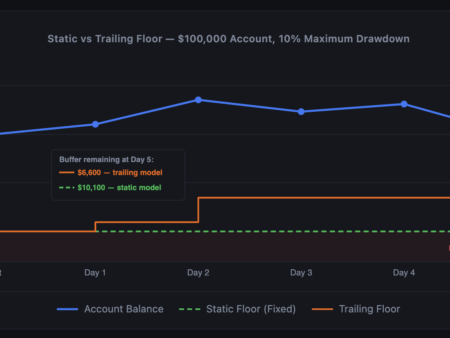
A trader can stay within the daily drawdown limit every day and still fail maximum drawdown over time. For example, losing 2 percent across several separate days may not breach the daily rule, but it can still push the account toward the total maximum loss limit.
Daily drawdown protects the account from one bad day. Maximum drawdown protects the account from total deterioration.
Both rules matter.
How Daily Drawdown Affects Strategy
Daily drawdown does not just limit risk. It changes how you trade.
Different trading styles are affected differently:
- Scalpers may be affected by frequent small losses and trading costs.
- Swing traders are more exposed to reset-time risk because open positions can carry floating losses into the next day.
- News traders may face fast equity movements that reach the limit before execution happens cleanly.
- High-risk traders may feel pressure after one early loss because the account suddenly has less room to recover.
There is also a psychological side. Once the daily buffer gets smaller, traders often change behavior. They may revenge trade, cut good setups too early, or avoid valid trades because the account feels too close to the limit.
The rule does not only control risk. It affects decision-making.
Common Mistakes Traders Make
Most daily drawdown breaches happen because the rule is misunderstood, not because the trader never read it.
Common mistakes include:
- Comparing only the daily drawdown percentage across firms
- Assuming every firm calculates the rule the same way
- Watching balance but ignoring equity
- Forgetting that floating losses may count
- Holding losing trades through reset without checking the new limit
- Confusing daily drawdown with maximum drawdown
- Choosing a cheaper challenge without checking the rule structure
The percentage is the easiest part to compare. It is also the least complete.
What to Check Before Buying a Challenge
Before buying a prop firm challenge, check the daily drawdown rule in the official rules page or help center.
Use this checklist:
| Question | Why It Matters |
| What is the daily drawdown percentage? | Shows the headline daily risk limit |
| What is it based on? | Initial balance, prior day balance, balance, and equity behave differently |
| Does floating loss count? | Open trades may reduce real room |
| Do fees count? | Costs can reduce usable buffer |
| When does it reset? | Affects overnight and multi-session trades |
| What timezone is used? | Your local time may not match the firm’s trading day |
| What happens if it is hit? | Pause and breach are very different outcomes |
| Does it change by program? | Rules may differ across account types |
| How does it interact with max drawdown? | Daily survival does not guarantee total account survival |
This is especially important because one firm may use different rules across different products. Do not assume the rule from one account applies to every account.
Final Takeaway
Daily drawdown is one of the most important rules in prop firm trading because it defines how much loss an account can take in a single trading day.
The percentage is only the surface. The real risk comes from the structure.
A trader needs to know what the rule is based on, whether floating losses count, when the reset happens, and what happens if the limit is reached. A 5 percent daily drawdown limit can feel manageable in one model and restrictive in another.
That is why traders should not compare firms by percentage alone. They should compare how the rule actually works.
A low challenge fee means very little if the daily drawdown rule is too tight, unclear, or poorly matched to the trading strategy.
If you misunderstand daily drawdown, you do not lose slowly. You can lose the account in one session.
Frequently Asked Questions
What is daily drawdown in prop trading?
Daily drawdown is the maximum amount a trader can lose in one trading day before the account is paused, restricted, or breached.
Is daily drawdown the same as daily loss limit?
In most cases, yes. Some firms call it daily drawdown, while others call it daily loss limit, maximum daily loss, daily pause, or daily simulated loss.
Does daily drawdown include floating losses?
It depends on the firm. Many prop firms include floating losses, which means open trades moving against the account can count toward the daily limit.
What happens if I hit the daily drawdown limit?
It depends on the firm and account type. Some firms pause trading until the next day, while others treat it as a full breach.
Why does daily drawdown reset time matter?
Reset time matters because open trades can carry floating losses into the next trading day. A position that looks safe before reset may become risky after the new daily limit starts.
What is the difference between daily drawdown and maximum drawdown?
Daily drawdown limits losses within one trading day. Maximum drawdown limits total account losses across the full challenge or funded account.
Is a higher daily drawdown better?
Not always. A higher percentage can help, but the calculation method matters more. Traders still need to check whether the rule is based on balance or equity, whether floating losses count, and whether hitting the limit causes a pause or breach.
Best Prop Firms

1 Out of 5 Crypto Holders Worldwide Is with Venus Trading
Buy, trade, and hold 900+ cryptocurrencies on Planet Pro
Buy, trade, and hold 150+ cryptocurrencies on Global Tower

Buy, trade, and hold 500+ cryptocurrencies on Creative Exchange
1 Out of 5 Crypto Holders Worldwide Is with Octopus



PropFirmTalks helps traders understand prop firm rules, compare firms, and make smarter funding decisions.
Quick Links