In prop trading, a drawdown rule sets a limit on how far your account balance or equity can fall. Reaching that limit may fail the account or stop trading temporarily, depending on the rule.
Before choosing an account, check how much you can actually lose and how the firm measures it. The account size alone does not answer either question.

Drawdown in Prop Trading

Table of Contents
Key takeaways
- The account size is not the amount you can lose.
- When daily and overall limits both apply, you must stay within both.
- Open losses may count; reaching a limit may pause trading or fail the account, depending on the rule.
What does drawdown mean?
Drawdown describes a fall in account value from a reference point, such as a previous high. Prop firms also use the term when describing their permitted loss limits.
A firm may call its rule Maximum Loss, Maximum Loss Limit or Daily Loss Limit. Check what the rule does: which value is measured, where the limit sits and what happens if you reach it.
A simple loss-limit example
Suppose an account starts at $100,000 and has a fixed overall loss allowance of $10,000. Its loss floor is $90,000.
With current equity of $96,000, the account has lost $4,000 from its starting value. The remaining distance to the $90,000 floor is $6,000:
$96,000 − $90,000 = $6,000
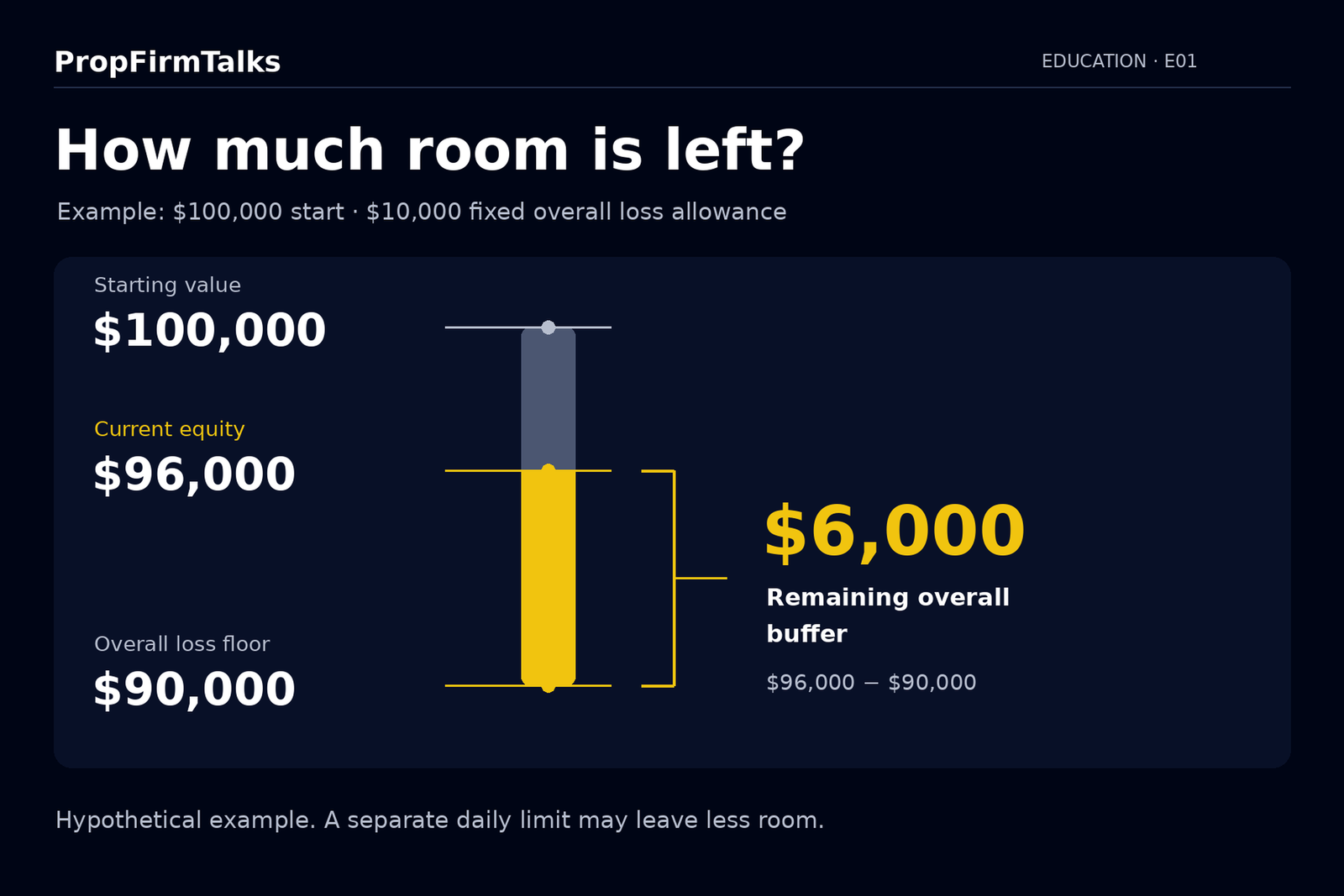
For this hypothetical example, equity below $90,000 breaches the overall rule. A real firm may instead treat touching its limit as a breach.
The $100,000 starting value is not the loss allowance. This example covers only the overall limit; a separate daily rule could leave less room.
Daily and overall loss limits
A daily loss limit controls losses within the firm’s trading day. Its calculation and reset time depend on the product.
An overall loss limit sets the account’s loss floor across trading days. That floor may stay fixed or move upward under a trailing rule.
When both apply, you must stay within both. You can still breach the daily rule while your account is above the overall floor.
For example, FTMO’s CFD 2-Step Challenge has a daily loss amount of 5% and a fixed overall loss allowance of 10% of initial simulated capital. For a USD $100,000 account in the Challenge evaluation phase, those amounts are $5,000 and $10,000. These are 2-Step rules, not a description of every FTMO product.
See our FTMO review for a side-by-side look at how the overall loss limit works on 1-Step, 2-Step and Instant.
See FTMO’s 2-Step product page for the published amounts; select 2-Step on its trading-objectives page for the full rules. For calculations and resets, read What Is Daily Drawdown in Prop Firm Rules? For the overall floor, read What Is Maximum Drawdown in Prop Firm Rules?
Open losses can count before a trade closes
Balance reflects closed trading results and posted account adjustments. Equity also reflects profit or loss on open positions.
If the rule checks equity, an open losing trade can bring the account to its limit before you close it. FTMO’s 2-Step objectives include open P/L, commissions and swaps in the equity check.
Topstep’s $50K Trading Combine illustrates why the account label and loss allowance are different: it starts at $50,000 with a $2,000 Maximum Loss Limit allowance and a $48,000 initial floor. Its limit is monitored during the session, including unrealised P/L. See Topstep’s Maximum Loss Limit explanation.
A daily stop does not always mean account failure
Topstep offers an optional Daily Loss Limit when you buy a Trading Combine. If you reach it, positions are closed and trading stops until the next session. That daily stop alone does not make the account ineligible for funding.
Breaching Topstep’s overall Maximum Loss Limit instead makes a Trading Combine ineligible for funding until it is reset. Check the consequence for your product and account phase. See Topstep’s Daily Loss Limit policy.
What to check before choosing an account
Read the official rules for the exact product and phase you intend to trade:
- Which daily and overall limits apply?
- What is the current loss floor, and can it move?
- Does the rule check balance or equity, and how are trading costs included?
- When does the daily limit reset or the overall floor update?
- Does touching the limit trigger action, or must the account fall below it? Does that action pause trading or fail the account?
FAQs
Does touching the loss floor count as a breach?
The wording differs. FTMO’s published 2-Step rule prohibits equity below its loss floor. Topstep’s Maximum Loss Limit triggers when the account touches the limit. Check the official wording for your exact product and phase.
Do daily and overall limits reset together?
Do not assume they do. A daily reset does not automatically restore the overall loss allowance. Check the daily-reset rule and overall-floor rule separately.
Final takeaway
Before you trade, know where your loss floor sits, what counts towards it and what happens if you reach it. Those details tell you how much room you actually have.
Best Prop Firms

FTMO offers simulated CFD accounts through its 1-Step and 2-Step Challenges. Its Instant Account lets traders start without an evaluation.

Swiss-based prop firm with Base Camp instant funding and Peak 2-step evaluation. Best understood by traders who read the rules carefully.

FundedX offers a wide mix of low-cost account models, including Turbo, 1 Phase, 2 Phase, and Instant Funding. A practical option for traders who value product variety and affordable entry.

PropFirmTalks helps traders understand prop firm rules, compare firms, and make smarter funding decisions.
Quick Links