Drawdown is one of the main reasons traders fail prop firm challenges, not because the percentage is hard to read, but because the rule behaves differently in live trading. This article explains how daily drawdown, maximum drawdown, static drawdown, and trailing drawdown actually work in practice, and why the structure matters more than the number.

Drawdown in Prop Trading Explained for Beginners

On paper, drawdown looks simple. In practice, it is one of the main reasons traders lose prop firm accounts.
That is what makes drawdown different from most other prop firm rules.
It is always there in the background, and different firms apply it differently. The structure matters more than the percentage. (FTMO.com)
Key takeaways
- Drawdown is not just a number. It is the rule that decides how much room your account actually has.
- The same percentage can behave differently depending on reset time, equity treatment, and firm structure.
- Floating loss is one of the biggest reasons traders breach accounts unexpectedly.
- Daily drawdown and maximum drawdown solve different problems and should not be treated as the same rule.
- A 5% daily loss limit is not “wide” if open trades, commissions, or swaps are counted.
- Static drawdown is usually easier for beginners to manage than trailing drawdown.
- The real question is not “what is the percentage?” It is “how does this rule behave while I am trading?”
- Before buying a challenge, always check the rule page, not just the product page.
What is drawdown in prop trading?
In simple terms, drawdown is the amount your account is allowed to fall before the firm treats it as a breach.
In prop trading, that is not just a performance metric. It is a hard operating rule.
The important part is not the dictionary definition.
The important part is how the firm measures that drop in real time. Some firms use equity, some reset daily from a defined reference point, and some treat overall loss as fixed while others trail it. (FTMO Academy)
How different firms apply it
The percentages may look familiar across firms.
The structure underneath is where traders get caught.
| Firm | Daily drawdown | Maximum drawdown | Important rule behavior |
|---|---|---|---|
| FTMO | 5% | 10% | Daily rule is based on equity and includes open positions, commissions, and swaps; recalculated at 00:00 CE(S)T (FTMO.com) |
| The5ers High Stakes | 5% | 10% | Daily drawdown is taken from the previous day’s closing equity or balance, whichever is higher, at 00:00 server time (The5ers Help Center) |
| FundedNext Stellar 2-Step | 5% | 10% | Daily loss resets at 00:00 server time; daily limit applies to running and closed losses (FundedNext Help Center) |
| FundedNext Stellar Lite | 4% | 8% | Tighter structure than standard 2-step models; same daily reset logic applies (FundedNext Help Center) |
| FundingPips | 5% | 10% | Standard headline structure, but traders still need to confirm how the daily loss is determined on the rules page (FundingPips) |
The lesson is simple.
A trader who only compares the 5% and 10% numbers can still misunderstand how the account actually behaves.
What really matters inside the rule
The percentage is only the surface.
These are the factors that decide whether a drawdown rule feels manageable or tight.
| Factor | Why it matters |
|---|---|
| What counts toward the loss | Open P/L, commissions, and swaps can reduce room before a trade is even closed |
| When the daily rule resets | Reset time changes how overnight trades behave |
| What reference point is used | Initial balance, prior closing equity, or highest value can all produce different outcomes |
| Whether the overall limit is static or moving | Fixed floors and trailing floors create very different trading pressure |
| How daily and overall limits interact | A trader can avoid one breach and still violate the other |
Floating loss reduces your room before trades are closed
This is one of the most misunderstood parts of prop firm drawdown.
A trader looks at closed balance, feels fine, and ignores what the open position is doing to equity.
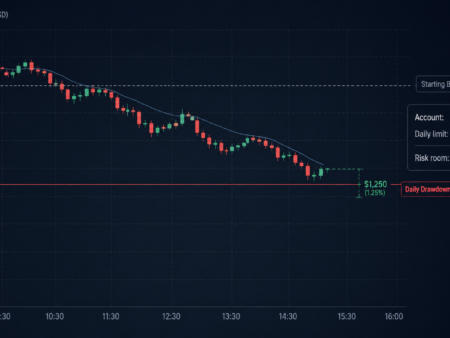
At FTMO, the Maximum Daily Loss rule is based on equity and includes open positions, commissions, and swaps.
That means the account can violate the rule even before the trade is closed. (FTMO Academy)
That is why traders often say, “I did not even close the loss yet.”
The firm may not care. The rule is measuring the live state of the account, not just the final result after you exit.
Reset time changes how daily drawdown behaves
Daily drawdown is not just “what you lose today” in a casual sense.
It is usually tied to a specific server reset time.
FTMO recalculates the daily loss reference at 00:00 CE(S)T.
The5ers uses 00:00 server time, and FundedNext also resets at 00:00 server time. (FTMO.com)
This matters because the same trade can behave differently before and after reset.
A position that feels manageable late in the session can become a problem once the next day’s limit starts fresh.
The reference point changes the real limit
Two firms can both advertise 5% daily drawdown and still mean different things.
That is because they may calculate the rule from different reference points.
The5ers High Stakes measures daily drawdown from the previous day’s closing equity or balance, whichever is higher.
FTMO recalculates the daily limit at 00:00 CE(S)T using its own equity-based framework. FundedNext uses the initial balance multiplied by the daily limit percentage for its daily-loss examples. (The5ers Help Center)
This is where beginners get misled by headline percentages.
The percentage only becomes meaningful once you know what the firm is measuring it against.
Static and trailing drawdown do not feel the same
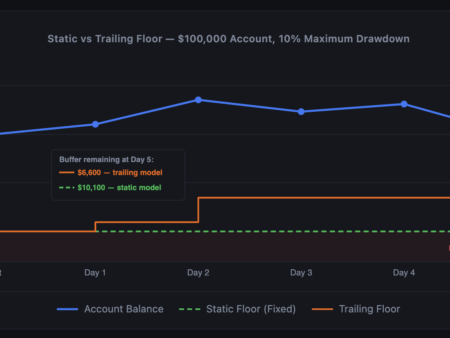
A static drawdown floor stays fixed.
A trailing drawdown floor moves when the account reaches new highs.
That difference changes how the account feels after profitable trading.
The5ers’ drawdown explanation shows that in some models, as the account rises, the maximum drawdown amount can rise too, which is a form of moving protection logic rather than a simple fixed floor. (The5ers Help Center)
This is why the same account size does not mean the same freedom.
A fixed floor usually gives clearer room to plan. A moving floor demands more awareness because profitable trading can tighten the account.
Scenario: how a trader breaches without realizing it
Take a $100,000 account with a 5% daily drawdown and 10% maximum drawdown.
| Item | Amount |
|---|---|
| Starting balance | $100,000 |
| Daily drawdown | $5,000 |
| Maximum drawdown | $10,000 |
Now imagine this sequence:
| Step | What happens | Account impact |
|---|---|---|
| 1 | Trader starts the day flat | Daily room = $5,000 |
| 2 | Trader goes up $1,200 | Feels safe |
| 3 | Trader gives it back and keeps trading | Emotional pressure increases |
| 4 | Open position drops to -$4,700 with commission and swap | Equity is much closer to breach than balance suggests |
| 5 | Market moves a little further against the trade | Daily rule is violated |
The trader often remembers the early profit and assumes there is still room.
That is the mistake. The rule is not based on memory. It is based on the account’s live condition under the firm’s method.
The overnight trap
This is one of the cleanest ways to fail a challenge without meaning to.
A trader holds a losing position across the daily reset because they expect a reversal.
Before reset, the trade is close to the daily limit but still alive.
After reset, the new day starts, but the open loss is still there, and the account is now being judged under a fresh daily-loss framework while the overall loss keeps building. (FTMO.com)
This is why “I will just hold it and let it recover tomorrow” is dangerous in prop trading.
Tomorrow may start with less room than the trader expects.
Daily drawdown vs maximum drawdown
Traders often blur these together.
They should not.
| Rule | What it controls | Why traders fail it |
|---|---|---|
| Daily drawdown | Short-term damage in one session | Overtrading, revenge trading, holding losers through reset |
| Maximum drawdown | Total account survival room | Stacking bad days, letting losers build, ignoring cumulative damage |
A trader can respect one and still break the other.
For example, staying under the daily cap for several days in a row can still grind the account into the maximum-loss floor.
How different trading styles are affected
Intraday traders usually feel daily drawdown first.
They trade more frequently, take more resets, and can create damage quickly if they keep pressing after a bad start.
Swing traders have a different problem.
They are more exposed to floating loss and reset-time issues, especially if positions are held through session changes or overnight.
Aggressive traders usually struggle more with moving drawdown structures.
Steadier traders usually handle fixed structures better because the account gives them a more stable reference point.
Common mistakes
- Looking only at balance and ignoring equity
- Treating daily drawdown like a soft guideline instead of a hard stop
- Assuming profit made earlier in the day creates permanent safety
- Holding losers through reset without checking how the firm recalculates the rule
- Comparing firms only by percentages without checking the reference point
- Confusing static drawdown with trailing drawdown
- Reading the product page but skipping the actual rules page
What to check before buying a challenge
| Question | Why it matters |
|---|---|
| What is the daily drawdown percentage? | The headline number shapes short-term risk |
| What is the maximum drawdown percentage? | This defines total survival room |
| Does the firm count floating loss? | This changes how much room you really have while trades are open |
| Does the rule include commissions and swaps? | Small costs can push a near-limit account into breach |
| When does the daily rule reset? | Overnight holds can behave very differently around reset |
| What reference point is used? | Initial balance, previous close, or another metric changes the true rule |
| Is the overall loss static or trailing? | Fixed and moving floors create different pressure |
| Is the rule explanation clear on the official page? | If the rule is unclear before purchase, it will be worse under stress |
Final takeaway
Drawdown is not just a percentage on a prop firm sales page.
It is the rule that decides how much room you actually have when the market moves against you.
That is why traders should stop asking only, “Is it 5% or 10%?”
The better question is, “How does this rule behave while I am trading?”
The structure matters more than the number.
If you understand that before you buy, you are already ahead of many traders who fail for avoidable reasons.
FAQ
What is drawdown in prop trading?
It is the loss limit that can breach your account if crossed.
Why do traders fail drawdown rules so often?
Usually because they misunderstand floating loss, reset time, or how the firm measures the rule live.
Is 5% daily drawdown standard?
It is common, but not universal. Some firms use tighter structures like 4%. (FTMO.com)
Is maximum drawdown the same as daily drawdown?
No. Daily drawdown controls one session. Maximum drawdown controls the total account loss.
Which is easier for beginners: static or trailing drawdown?
Usually static, because the floor stays fixed and is easier to plan around.
Should I trust the headline rule on the product page?
No. Always confirm the full wording on the official rules or help-center page.
Best Prop Firms

1 Out of 5 Crypto Holders Worldwide Is with Venus Trading
Buy, trade, and hold 900+ cryptocurrencies on Planet Pro
Buy, trade, and hold 150+ cryptocurrencies on Global Tower

Buy, trade, and hold 500+ cryptocurrencies on Creative Exchange
1 Out of 5 Crypto Holders Worldwide Is with Octopus



PropFirmTalks helps traders understand prop firm rules, compare firms, and make smarter funding decisions.
Quick Links