
The Rule That Defines How Much Room You Actually Have
Most traders compare prop firms by price, profit split, or payout speed. But maximum drawdown often matters more than any of those, because it defines the total room the account gives you before a breach ends everything. The catch is that prop firms do not calculate it the same way. A 10% maximum drawdown at one firm can be far more forgiving than 10% at another, depending on whether the rule is fixed, trailing, balance-based, or equity-based.
Understanding the structure behind the number is what separates traders who choose a challenge that fits their style from those who breach an account they thought was manageable.
- Maximum drawdown is the overall loss floor an account cannot breach — not just a percentage to memorise.
- Firms use different models: fixed from initial balance, trailing with profits, or anchored to the highest balance ever recorded.
- A trailing maximum drawdown can tighten during profitable periods, making it more restrictive than a fixed rule with the same headline number.
- Equity-based rules count floating losses on open positions — not only closed trades.
- Higher maximum drawdown is not automatically better. The full model determines what the percentage actually means in live trading.
- The same firm can apply different maximum drawdown models across different products.
This article focuses on CFD prop firms only. The firms used as examples throughout — FTMO Topstep For Traders FORFX Global Forex Funds — each handle maximum drawdown in a distinct way. That variation is the point.
What Maximum Drawdown Actually Means
In general finance, maximum drawdown refers to the largest peak-to-trough decline in a portfolio over a given period. In prop firms, the meaning is more specific and more immediate: it is the overall loss limit that the account cannot breach before the trader is disqualified.
Most firms apply this rule throughout both the evaluation and funded phases, though the exact mechanics can differ between them. You may see it labelled differently depending on where you look:
- Maximum Drawdown
- Maximum Loss
- Maximum Loss Limit
- Overall Loss
Regardless of the label, the function is the same — it sets the floor below which the account cannot fall. What changes between firms is how that floor is defined, and whether it moves.
Maximum drawdown is not just the total loss limit. It is a rule whose structure — fixed, trailing, balance-based, or equity-based — determines what that limit actually feels like in real trading.
How Maximum Drawdown Works Across Prop Firms
The most important thing to understand is that this rule is not universal. Firms use meaningfully different models, and the same headline percentage can represent very different real conditions. Three main models are in active use.
Fixed from initial balance
Some firms set the loss floor once, based on the starting account balance, and it never moves. FTMO uses this approach, defining its Maximum Loss as equity not falling below 90% of the initial account balance. On a $100,000 account, the floor is permanently at $90,000 — regardless of whether the account has grown or shrunk since day one.
Trailing with profits
Topstep applies a trailing model through its Maximum Loss Limit, which follows the account upward as the balance increases. If a trader grows a $100,000 account to $105,000, the floor moves up with them. The available buffer can tighten over time even if the headline percentage sounds identical to a fixed-model firm.
Based on highest balance ever recorded
For Traders applies a version of this logic on its One-Step Challenge, where the maximum drawdown is anchored to the highest balance the account has ever reached — not just the current balance. On its Two-Step Challenge, the rule is balance-based and fixed. That difference alone makes the two products behave very differently in practice, even within the same firm. Both are documented in the firm’s General Rules page.
| Firm | Model Type | Anchor Point |
|---|---|---|
| FTMO | Fixed | Initial balance (equity-based) |
| Topstep | Trailing | Follows profits upward |
| For Traders (Two-Step) | Fixed | Balance |
| For Traders (One-Step) | Trailing | Highest balance ever recorded |
| FORFX | Varies by product | Check specific program |
Before comparing percentages, identify which model a firm uses. A fixed floor and a trailing floor are not the same product — even when labelled with identical numbers.
For a full breakdown of how these two approaches differ in practice, see Static vs Trailing Drawdown.
Static vs Trailing Maximum Drawdown
This distinction is where most beginners make their first analytical mistake when comparing challenges.
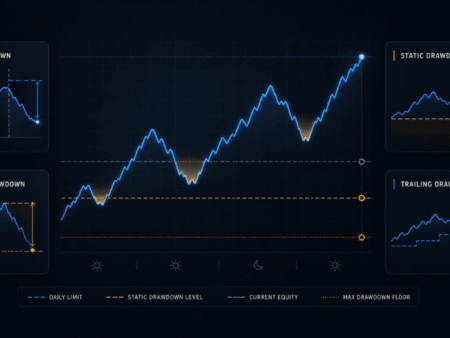
A static maximum drawdown is fixed at the point of account opening and does not move. The floor stays at the same dollar value regardless of whether the trader gains or loses after that point.
A trailing maximum drawdown moves upward as the account grows. The floor follows profits, which means the practical buffer available to the trader can shrink — even during a winning period.
A trader on a trailing model grows their $100,000 account to $108,000. The floor has now followed that growth. A normal pullback that would have been comfortable under a fixed model may now bring the trader dangerously close to breach — not because they did anything wrong, but because winning earlier reduced the buffer available now.
Topstep is the clearest live example of trailing logic applied at scale. Traders evaluating its Maximum Loss Limit should consider how the rule behaves during profitable periods, not only during losing ones.
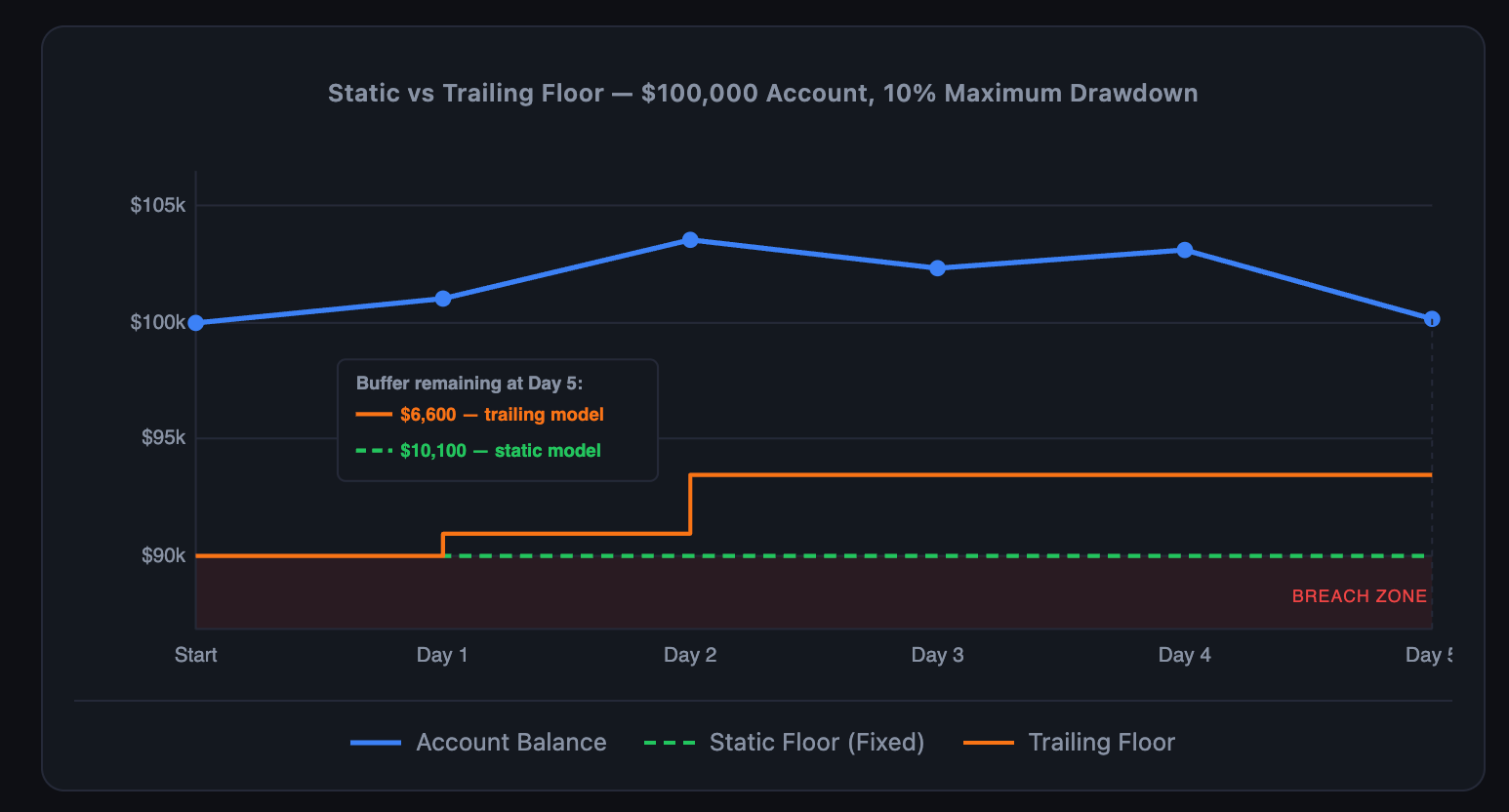
Here is what that difference looks like in practice. Both models start with a $100,000 account and a 10% maximum drawdown — identical on paper. The visual and table below show what happens to each floor as profits arrive, and what the buffer looks like when the balance drops on Day 5.
The table below tracks each floor day by day. Pay attention to what happens to the trailing buffer from Day 3 onward — the floor has locked in higher and does not come back down when the balance drops.
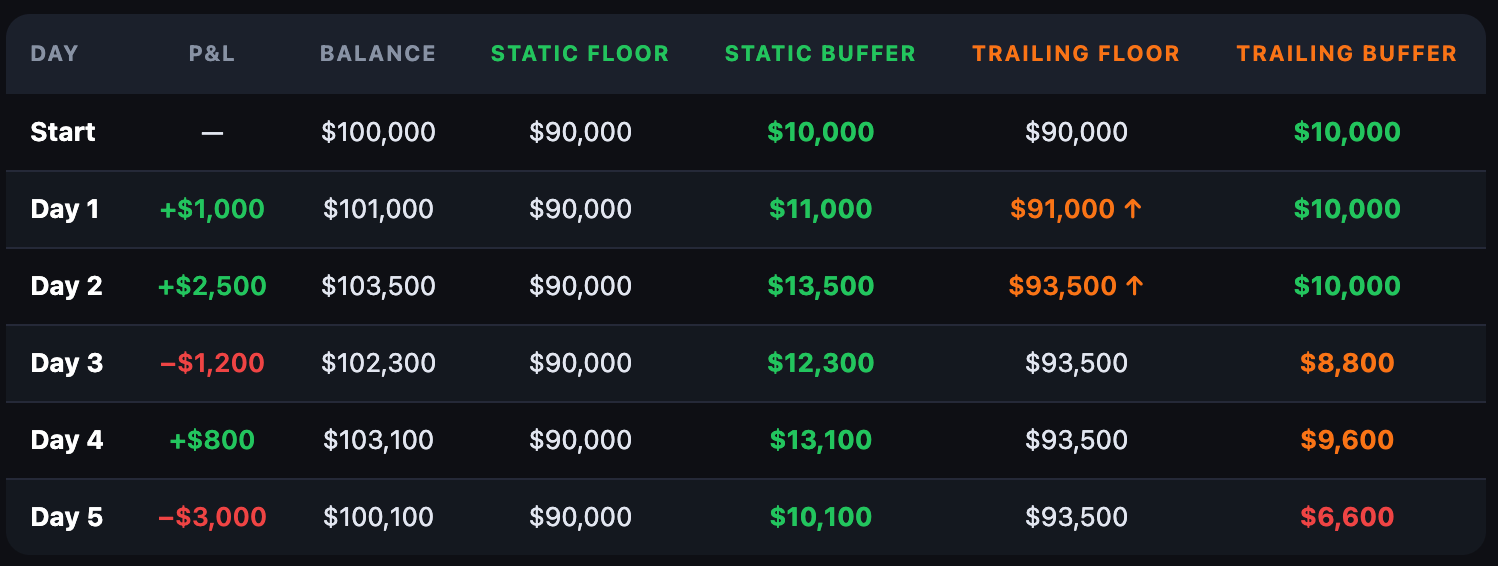
After Day 5, both accounts hold roughly the same balance — $100,100. The static buffer is $10,100, nearly where it started. The trailing buffer is $6,600, because the floor locked in at $93,500 during the profitable Days 1 and 2 and cannot move back down. Same balance. Same starting percentage. Very different room left in the account.
For a deeper explanation of each model, see What Is Trailing Drawdown? and What Is Static Drawdown?.
Initial Balance vs Highest Balance vs Equity
Three different anchors are in active use across the industry, and each one changes what the percentage actually means in practice.
Initial balance
The simplest model. The floor is calculated once from the starting account value and stays there permanently. FTMO uses this approach, which means a trader who grows the account still has the original floor protecting their downside — the buffer does not shrink with success.
Highest balance
The most demanding anchor. The floor recalculates each time the account reaches a new peak. For Traders applies this on its One-Step Challenge. A trader who hits a new high-water mark is now measured against that point, not the original starting balance — which reduces effective room for normal variance after every profitable run.
Equity-based calculation
FTMO specifies that its Maximum Loss rule is measured against equity, not closed balance. Equity includes open positions, commissions, and swap charges. This means a trader can approach or breach the floor through floating loss on open trades — not only from realised losses.
A trader watching only their closed balance thinks they have $7,200 of room. A trader who understands the equity-based rule knows they have $2,400. A position running against them does not need to be closed to eat into the maximum drawdown limit.
If your firm uses an equity-based rule, your actual buffer at any moment is your equity minus the floor — not your balance minus the floor. These are rarely the same number when you have open positions.
Maximum Drawdown vs Daily Drawdown
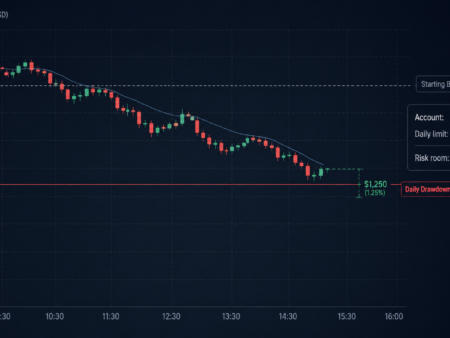
These two rules are often confused, but they operate on entirely different timeframes and serve different functions. Both can independently end an account.
| Feature | Daily Drawdown | Maximum Drawdown |
|---|---|---|
| Timeframe | Resets every day | Entire challenge lifetime |
| What it measures | Loss within one trading day | Total account loss from reference point |
| Typical range (CFD firms) | 4–5% | 8–12% |
| Consequence if hit | Pause or account breach | Account termination |
| Can it accumulate? | No — resets daily | Yes — builds across sessions |
A trader can stay within the daily drawdown limit every single day and still fail the account — if losses accumulate across enough sessions to reach the maximum drawdown floor. Neither rule tells the complete story on its own. Both must be tracked in parallel. FTMO documents both rules separately — its Maximum Daily Loss and its Maximum Loss — precisely because they govern different timeframes and trigger independently.
For a full explanation of the daily rule — including how Topstep documents its Daily Loss Limit separately from its Maximum Loss Limit — see What Is Daily Drawdown in Prop Firm Rules? For a direct comparison of both limits together, see Daily Drawdown vs Maximum Drawdown.
Is Higher Maximum Drawdown Actually Better?
Some firms and programs offer larger buffers. Global Forex Funds shows 10% maximum drawdown on its main pricing page. FORFX lists 12% maximum drawdown on one of its two-phase structures — compared to 10% on another within the same firm. That variation reinforces the point that readers need to evaluate the specific program, not just the brand name.
A higher maximum drawdown can be genuinely more forgiving. It gives traders with wider stop placements, longer holding periods, or naturally swinging equity more room to operate without living near the breach threshold. For swing traders or lower win-rate strategies built around high reward-to-risk ratios, additional buffer is a structural advantage — not just a comfort preference.
But bigger is not automatically better, for three reasons:
A trailing model with 12% can tighten faster during a winning period than a fixed model with 10%. The percentage alone does not tell you how the floor moves.
More room to lose is only an advantage if the trader still manages risk responsibly within it. A larger headline number is not permission to size up or let losses run further than strategy logic dictates.
12% from the initial balance and 12% from the highest balance ever recorded are not equivalent. A trader who has grown their account significantly will find the highest-balance version far more restrictive, regardless of how generous the headline sounds.
How Maximum Drawdown Affects Strategy Fit
The drawdown model is not just a compliance rule — it actively shapes what a strategy can do on that account. Two traders with the same percentage tolerance can end up in very different situations depending on the model the firm uses.
Scalpers
Tight stops and high frequency mean the overall maximum drawdown floor is rarely the primary concern day-to-day. But equity-based rules still apply during sessions with multiple open positions running simultaneously — an unrealised drawdown across several live trades adds up faster than it appears on a single position basis.
Swing traders
Positions held overnight or across several days are directly exposed to floating loss counting toward equity-based rules. A model that measures equity rather than closed balance can make swing trading significantly more difficult than the headline number suggests. This is especially relevant for firms that use an end of day trailing drawdown — where the floor recalculates at the close of each session, capturing any open position loss before the next day begins. Check the anchor and the measurement basis before choosing an account for a swing strategy.
Lower win-rate, high reward-to-risk traders
These strategies need drawdown tolerance during normal losing streaks. A fixed, generous maximum drawdown can accommodate this naturally. A trailing model may tighten exactly when the strategy is in its expected losing phase — which is the worst time for the buffer to shrink.
Traders vulnerable to emotional pressure
A rule that feels suffocating mid-trade accelerates poor decisions regardless of whether it has technically been breached. Effective buffer — the actual distance between current equity and the floor in real dollar terms — matters as much as the stated percentage. A tight effective buffer changes how a trader behaves, usually for the worse.
Common Mistakes Traders Make
Most traders who fail a prop challenge on a maximum drawdown breach do not fail because they ignored the rule. They fail because they misread how it was being calculated. These are the errors that end accounts most often.
Two firms showing 10% maximum drawdown can have completely different practical rules if one is fixed and one is trailing, or if one measures equity and the other measures closed balance. The number is not the rule — the model is. For a full side-by-side breakdown of how these two structures diverge in real account conditions, see Static vs Trailing Drawdown.
FTMO, Topstep, For Traders, and FORFX all use different models. And within FORFX and For Traders, different products within the same firm apply different rules. Never carry assumptions from one challenge into another.
If the rule is equity-based, open positions are already counting against the floor before a single trade is closed. Watching only the closed P&L gives a false picture of real exposure.
A larger percentage with a trailing or highest-balance structure can be more restrictive in practice than a smaller percentage with a fixed structure. Run the actual numbers for your strategy before concluding that a higher number is better.
Some firms apply different maximum drawdown rules to the evaluation phase and the funded phase. Always read the rules for both stages separately, not just the one you are currently in.
What to Check Before Buying a Challenge
Before spending money on any CFD prop firm challenge, go through these questions using the firm’s official rules page — not the marketing page. If a firm cannot answer all of these clearly in writing, that itself is important information.
- Is the maximum drawdown static or trailing?
- Is it measured against balance or equity?
- Is it anchored to the initial balance or the highest balance ever reached?
- Do floating losses on open positions count toward the rule?
- Does the rule change between the evaluation phase and the funded phase?
- Does the same firm apply different maximum drawdown rules across different products?
FTMO, For Traders, and FORFX all demonstrate why this checklist is necessary — each firm applies its own model, and within a single firm, different products can carry meaningfully different rules.
For a broader framework on evaluating prop firm rules before you buy, see Drawdown in Prop Trading.
Final Takeaway
Maximum drawdown is one of the most consequential rules in prop trading because it defines the total room an account has before failure. But traders who compare only the percentage are reading an incomplete picture.
Here is what this article covered:
- Maximum drawdown is the overall account floor — not just a number to note and forget.
- Firms use different models: fixed from initial balance, trailing with profits, anchored to highest balance.
- Equity-based rules count floating losses — not only closed trades.
- A trailing model can reduce effective buffer during profitable periods.
- Higher maximum drawdown is not automatically better — the structure determines what the percentage actually means.
- The same firm can apply different rules across different products. Always check the specific program.
A challenge that looks attractive on the homepage can feel very different once the drawdown model begins shaping real decisions under pressure. Understanding how the rule is calculated — not just what it says — is what makes the difference between choosing well and finding out too late.
Frequently Asked Questions
What is maximum drawdown in prop trading?
In prop trading, maximum drawdown is the overall loss limit that an account cannot breach before the trader is disqualified. It functions as the live floor that the account must stay above throughout the evaluation and funded phases. It is different from the general finance definition, which refers to the largest historical decline in a portfolio over time.
Is maximum drawdown the same as max loss?
Yes, in most prop firm contexts these terms refer to the same rule. Firms use different labels — Maximum Drawdown, Maximum Loss, Maximum Loss Limit, Overall Loss — but all describe the overall breach threshold for the account. Always check the official rules page to confirm which term the firm uses and how it defines the calculation.
What is the difference between daily drawdown and maximum drawdown?
Daily drawdown limits how much loss can occur in a single trading day. Maximum drawdown limits total cumulative loss across the account’s entire lifetime. Both rules can trigger a breach independently. A trader can pass the daily rule every session and still fail the challenge if losses accumulate across multiple days and reach the maximum drawdown floor.
Is maximum drawdown based on balance or equity?
It depends on the firm. FTMO bases its Maximum Loss rule on equity, which includes open positions, commissions, and swaps — meaning floating loss on open trades counts toward the rule before those trades are closed. Other firms anchor the rule to closed balance only. Always check the specific rule language before assuming which applies to your account.
Is higher maximum drawdown better?
Not automatically. A higher percentage can be more forgiving for strategies with wider stops or natural equity swings. But a trailing structure can tighten the effective buffer faster than a smaller fixed drawdown. The full model — not just the headline number — determines whether a rule actually suits the strategy and trading style.
What is the difference between static and trailing maximum drawdown?
A static maximum drawdown is fixed from account opening and does not change. A trailing maximum drawdown follows profits upward, meaning the floor rises as the account grows. Trailing models reduce the available buffer during profitable periods, which can make them more restrictive in practice than they appear on a product page — even when the stated percentage looks identical to a static model.
Continue Learning
Go deeper on the specific drawdown rules that matter most to your trading style.